Human Wildlife Reserve Buoy
Gate CrashersThe Human Wildlife Preserve buoy is the artifact recovered by the AEUS Magellan in deep space and the material object through which humanity learns that its apparent isolation has been deliberate. Its discovery begins as a scientific anomaly, but its signals, structure, and disappearance eventually reveal a political order that has classified Earth as a controlled human preserve. The buoy therefore changes the meaning of exploration: the humans believe they are pushing into unknown territory, while another civilization has already drawn a boundary around them and has been watching from beyond it.
Discovery and Physical Appearance
The buoy first appears as an object sixteen meters long, less than two light-hours ahead of the AEUS Magellan. It is not on an intercept course, or indeed on any course at all. That stillness is what makes it so disturbing to Magellan, whose sensors have identified and destroyed millions of particles but have never encountered an object without motion or inertia. The artifact is large enough to be more than space dust, yet apparently harmless, leaving the ship with an unsettling paradox rather than an immediate tactical problem.
As the ship approaches, the object’s artificial nature becomes unmistakable. Its shell is primarily titanium with traces of other metals, a composition as unlikely to occur naturally as a petrified tree made of Portland cement. Later analysis identifies a titanium-and-palladium alloy unknown on Earth or in any human colony. From the crew’s first close view, the artifact resembles a polished silver hourglass stretched by a taffy puller. It is about the length of an airbus, seamless, and marked by tiny micrometeor craters. A block of unintelligible characters is engraved into one of its metal lobes, converting the object from an unexplained mass into a message-bearing thing before the message itself can be read.
The object’s materiality repeatedly resists ordinary categories. It is first treated as a probe, but its behavior and construction do not fit that label. Felix Fletcher eventually identifies the decisive distinction: “It’s a buoy. The artifact isn’t a probe. It’s a buoy.” The change in terminology is not cosmetic. A probe implies a vehicle sent to gather information; a buoy implies a marker, a fixed point in a larger system, and a device whose meaning depends on the territory it marks.
Signals, Interior, and Scientific Investigation
The buoy’s communications deepen rather than resolve the mystery. Its signal is detected only after the AEUS Magellan has drawn closer, and the recorded transmission is so bizarre that it is compared to what might result if Salvador Dalí had composed music. The ARTists project, the Artifact Research Team assembled to study the object, therefore approaches it through a growing network of instruments, logs, specialists, and institutional decisions rather than through a single act of interpretation.
The investigation discovers that the buoy has no conventional power source. Felix reports that it has “no power source,” even though it possesses abundant power and can operate a transmitter. The energy appears to come from nowhere within the researchers’ available explanations. This impossible power system makes the buoy more than a passive container of information: its material design actively determines what human science can and cannot claim to understand.
Its interior is equally alien. After an opening appears in the shell, blue engravings flash and a white line traces a circle through the metal. The completed circle moves outward, pivots downward, and exposes a hole in the hull. Inside, lights pulse and flow through transparent structures, resembling a bioluminescent fish. Later examination of a sphere associated with the device finds nothing inside it except another dimension, and not one of the thirteen dimensions predicted by the Third and Final Theory of Everything. The buoy’s apparent emptiness thus conceals an inaccessible spatial architecture, turning the object into a threshold as well as a transmitter.
The investigation is also vulnerable to human institutions. Eugene Graham presents the artifact and its signal when Felix is introduced to the ARTists project, explaining that the AEUS Magellan had reported it twenty-five days earlier and that its alloy was neither terrestrial nor colonial in origin. Later, classified ARTists memos, technical papers, schematics, and internal communications are leaked through Loose Lips Ezine. The buoy consequently becomes entangled with administrative secrecy and political struggle: knowledge of the object is valuable precisely because it may determine humanity’s position in the wider galaxy.
The Preserve Warning and the Fence
The first translated message changes the object’s identity again. A linguistic memo labeled Signal 1 Translation reads: “HUMAN WILDLIFE PRESERVE. KEEP OUT.” The warning is short, grammatically blunt, and devastating in its implications. It does not address humanity as an equal civilization seeking contact. It identifies humans as wildlife and the surrounding region as a preserve, while the command to keep out places the humans on the wrong side of a boundary they did not know existed.
The warning provokes a dispute over whether the buoy network constitutes a cage. Gladstone Rockwell argues that humanity has been “caged like zoo animals,” while Eugene Graham distinguishes a network of buoys from an actual enclosure and suggests that the devices may mark territory reserved for humans. Rockwell’s sarcastic response—that it is generous of outsiders to decide what human territory will be—exposes the asymmetry beneath Graham’s more cautious interpretation. Whether the network is called a cage, a fence, or a buffer zone, the humans did not choose its limits and were not consulted about the authority that imposed them.
The later explanation is more limited, but not necessarily more comforting. The fence was designed to warn outsiders away from Earth space and provide a buffer while humanity developed; it was not intended to imprison humans within the boundary. Its message plays in the languages of the Assembly of Sentient Species rather than in humanity’s own language because it was aimed at other members of the galactic community. This detail makes the buoy a sign addressed over humanity’s head. Humans are the subject of the warning, but not its assumed audience.
The scale of the network becomes another source of unease. When Jacqueline Dorsett observes that a thirty-light-year-radius sphere would require many buoys, the isolated artifact expands into an infrastructure. It is not an accidental relic but one node in a deliberately maintained spatial system. The object’s significance lies not only in what it contains, but in what its existence implies about countless unseen companions.
Surveillance, Withdrawal, and the Preserve’s Meaning
The buoy network is connected to active observation, not merely passive boundary marking. On Culpus-Alam, an observation post hidden beneath the ground contains smooth walls threaded with iridescent organic wires like those inside the buoy. When the room is entered, its systems illuminate and display a dozen views of a human village: women and children move along dirt roads and boulevards, unaware that they are being watched. The discovery makes the buoy’s function morally sharper. The preserve is not simply protected from intrusion; its inhabitants are objects of study.
Vel Noric confirms that Culpus-Alam was set aside generations earlier as a controlled environment for observing transplanted human tribes. The experiment allowed distinct cultures to develop and was intended to produce contact among the tribes so that the Assembly of Sentient Species could better predict humanity’s eventual integration into galactic society. The buoy therefore belongs to a wider apparatus of classification, separation, observation, and managed contact. The humans under observation are not merely threatened by an alien empire; they are being processed as a problem of knowledge and governance.
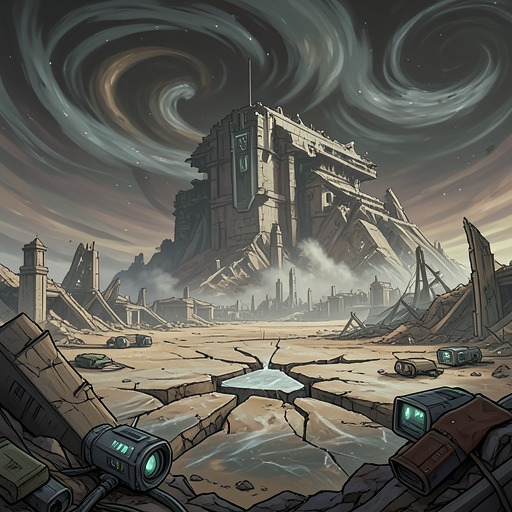
The preserve’s supposedly stable order is exposed when Buoy #4258743-E disappears. D’armic has surveyed more than three thousand buoys over six farlems and has never found one out of position. This buoy, however, sends no signal, and its exaggerated active-sensor signature is absent even though nothing larger than dust appears nearby. D’armic recognizes the consequence in a stark image: there is a hole in the fence. The missing buoy converts an invisible boundary into a breach and makes the protected arrangement vulnerable to movement in both directions.
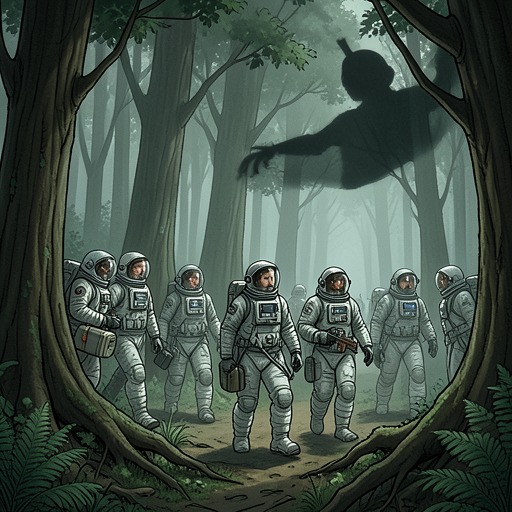
The object also exposes a hierarchy of gazes. Humans discover an observation post monitoring the Pirikura and ask why beings who pose no threat should be spied upon. Yet the same logic has already been applied to humanity. Earth is observed, fenced, classified, and discussed by outsiders who regard this management as reasonable. The buoy thus reverses the assumed position of the explorer: the humans are not simply observers moving outward into space, but observed beings who have mistaken their enclosure for the natural limits of the universe.
Political Consequences and Narrative Significance
The buoy’s disappearance and the humans’ actions around the network contribute to the crisis that follows. By crossing the boundary, recovering or appropriating Assembly property, and resisting the restrictions associated with the preserve, Allison Ridgeway and her crew become vulnerable to prosecution by the Assembly of Sentient Species. At the hearing, Ruckk describes their conduct as piracy of Assembly property and violation of Assembly space before listing the later charges of serial geocide and the destruction of an Assembly vessel. The buoy is therefore not an isolated scientific curiosity; it is a legally owned and politically charged object whose possession becomes evidence against humanity.
At the same time, the humans reject the position assigned to them. Maximus Tiberius refuses to cower behind the fence like domestic sheep and argues that the preserve’s designers have learned little about humanity if they expect passive obedience. His challenge does not erase the violence that follows, but it makes the buoy the focus of a conflict over whether protection can be imposed without consent. The device embodies a paternalistic claim: outsiders may define a boundary as benevolent while those inside experience it as surveillance and dispossession.
Its narrative role is therefore both technological and symbolic. The buoy is a machine that transmits signals, opens dimensional interiors, stores or enables observation, and participates in a network extending across interstellar space. It is also the first object to force humanity to confront a nonhuman definition of humanity itself. The phrase Human Wildlife Preserve reduces a technologically ambitious species to an observed life-form, while the buoy’s later absence proves that even a supposedly secure system depends on material nodes that can fail, vanish, or be taken.
The object’s decisive irony is that it begins as proof of human discovery and ends as proof that humanity has already been discovered. Its polished shell, impossible power, strange signal, dimensional interior, warning message, and place within the galactic fence all move the story from wonder toward accountability. The buoy does not merely announce that other civilizations exist. It reveals that those civilizations have been making judgments, drawing borders, conducting experiments, and waiting for humanity to become ready—or dangerous enough—to enter their history.